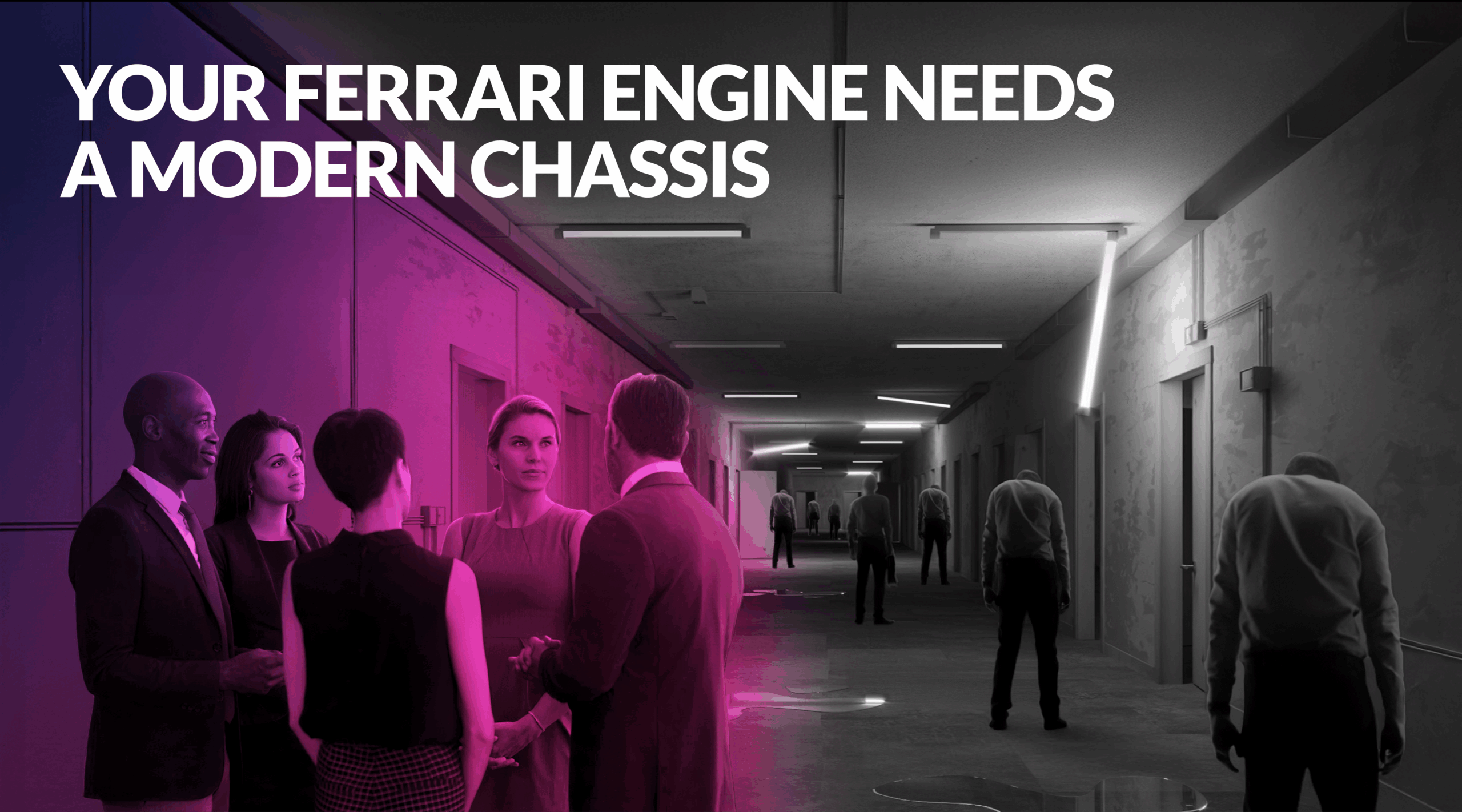
PART 3: YOUR FERRARI ENGINE NEEDS A MODERN CHASSIS – STOPBOLTING INNOVATION TO INDUSTRIAL-AGE INFRASTRUCTURE
Estimated reading time 7 minutes
The Infrastructure Reality Check
So you’ve started breaking those soul-crushing routines and genuinely empowering your people. Everyone’s fired up, ready to take ownership and make things happen. Fantastic. But what if your underlying structures, tech, and team setups are still stuck in the Industrial Age?
It’s like having that Ferrari engine we’ve been talking about, but it’s still bolted to a horse-drawn
carriage. All revs, no revolution.
You can have the most empowered, accountable culture on the planet, but if your people are fighting outdated systems, tangled in siloed teams, or working without a clear operating model, their energy will dissipate into frustration, not results.
Technology: The Enabler, Not The Saviour
Let’s get one thing straight: buying the latest, shiniest tech won’t magically transform your business. Too many organisations throw money at software solutions, hoping for a miracle, while their core ways of working remain fundamentally broken. Garbage In. Garbage Out. Right?
Technology should enable your new ways of working, not dictate them or become another layer of complexity.
Ask yourself:
- Does our tech help teams collaborate seamlessly, or create more silos?
- Does it provide easy access to the data people actually need to make empowered decisions, or is it a labyrinthine nightmare?
- Is it automating grunt work so our smart people can focus on high-value tasks, or is it just another system they have to “feed”?
- Most importantly: Does our tech make it easier for people to surface problems, share knowledge, and learn from failures across the organisation?
If your current tech stack feels more like a digital ball and chain than a launchpad, it’s time for a rethink. And this isn’t just the CIO’s problem – it’s a C-suite strategic imperative. Your technology choices must actively support the agile, empowered culture you’re building.
Cross-Functional Teams: Smashing Silos for Speed
Remember those “well-oiled processes” that turn into corporate sludge? A primary cause is functional silos. Marketing does their bit, throws it over the wall to sales, who loop in product, who eventually talk to (or engineering for our American friends) … and somewhere along that convoluted chain, the customer’s actual need gets lost, and speed dies a slow, painful death.
That Ferrari? Back in the garage, racking up bills as your sales decline.
Enter truly cross-functional teams. Not (pray god) committees that meet occasionally, but dedicated groups from different disciplines (product, design, IT, marketing, sales, support) who are collectively responsible for a specific customer outcome from end-to-end.
But here’s what most organisations miss: throwing people from different functions together doesn’t automatically create collaboration. It often creates cross-functional dysfunction.
The Hidden Barrier to Cross-Functional Success
When you mix marketing people, engineers, product managers, and salespeople, you’re not just combining skill sets – you’re colliding cultures, jargon, priorities, and deeply entrenched tribal loyalties.
Without psychological safety across functions:
- The marketing person won’t challenge the technical approach because they fear looking stupid to the engineers
- The engineer won’t question the business assumptions because “that’s not their lane”
- People hide their functional ignorance instead of learning from each other
- Mistakes get buried until they become expensive disasters
- Innovation dies because the best ideas come from unexpected intersections that people are too scared to explore
Building Cross-Functional Psychological Safety
This requires deliberate design, not hope:
- Make Ignorance Normal In your first cross-functional team meeting, have everyone admit one thing they don’t understand about another function’s work. Make it a requirement, not optional. Show that curiosity across disciplines is valued, not vulnerability.
- Create Translation Rituals Ban jargon in cross-functional discussions. Each function must explain their ideas in terms the others can challenge. When someone says “We need to optimise the conversion funnel,” make them explain what that actually means and why it matters to the customer.
- Reward Cross-Functional Friction When a marketing person respectfully challenges an engineering decision, celebrate it. When a salesperson questions a product feature, highlight the value. Make it clear that productive cross-functional tension leads to better faster outcomes.
- Joint Failure Analysis When cross-functional experiments don’t work, conduct joint post mortems. Focus on system failures and learning, not individual or functional blame. Share insights across all teams.
The Benefits: Faster decision-making (the right people are already in the room), increased innovation (diverse perspectives create sparks), and a much clearer line of sight to customer value.
Challenges: It requires breaking down traditional departmental barriers, which can feel threatening to existing power structures. It demands leaders who can foster collaboration over empire-building. Most critically, it requires creating safety for people to be vulnerable across functional boundaries.
If you’re serious about innovating your ways of working, cross-functional collaboration must become the norm, not the exception… it may take some banging of heads together at the start, but keep putting in the effort and the magic will happen.
The Product Operating Model: From Projects to Value Streams
This is the big one. For many established companies, it’s a fundamental identity shift. Are you a collection of discrete projects, or are you a living, breathing organism designed to deliver continuous value through products and services?
A Product Operating Model means:
- Durable, empowered teams aligned to value streams, not temporary projects
- Customer-centricity at the core built around understanding and serving customer needs continuously
- Outcome over output where success measured by actual impact, not features shipped
- Agility baked in and designed for rapid learning, adaptation, and market response
- Psychological safety embedded in how teams learn, fail, and iterate together
Moving to a product operating model isn’t just rejigging an org chart. It’s a cultural and operational transformation that requires funding teams and value streams, not just projects. It means different KPIs, different career paths, and a different way of leading.
And it absolutely requires psychological safety at scale – teams need to feel safe to experiment, surface customer problems, and pivot when data conflicts with assumptions.
The Challenge: Stop Tinkering, Start Re-architecting
This isn’t about gentle tweaks around the edges. This is about fundamentally redesigning your organisational chassis so that empowered people, using enabling technology, in collaborative teams, can actually drive your business forward at speed.
Your Action Plan:
- Pick One Critical Value Stream: Map it end-to-end. Where are the silos? Where is tech hindering? How could a dedicated, cross-functional team radically improve flow and outcomes? Pilot it (FAST)
- Audit Your Tech with Brutal Honesty: Does it genuinely accelerate your teams and support collaboration, or is it a clunky impediment? What’s one high-impact change you could make?
- Ask Your Newly Empowered Teams: “If you could restructure how we work on [Product X] to deliver massive value faster, what would it look like?” You’ve empowered them – now listen to what they say about the system they work within.
- Design for Cross-Functional Safety: Create rituals, processes, and norms that make it safe for different functions to challenge each other, admit ignorance, and learn together. Make productive cross-functional friction a competitive advantage
The Revolution Is Complete
Breaking old rhythms, fostering true empowerment and accountability, then redesigning your operational chassis – this is the real path to sustainable competitive advantage. It’s not easy, but it’s a hell of a lot more effective than doing what you’ve always done and hoping for different
results.
This is how you stop just doing business and start truly designing how your business gets done. Over this three part series, we’ve taken you through the essential stages of breaking organisational inertia:
- Recognising that your comfortable routines are the enemy of innovation
- Empowering your people with real authority and accountability
- Re-architecting your infrastructure to support sustainable transformation
The revolution doesn’t end here – it’s just beginning. Your organisation has the potential to be a rebel force in your industry, but only if you’re willing to challenge everything and rebuild it better… – with the courage to be vulnerable, make mistakes, and learn faster than your competition.
Ready for our next podcast? Join us next week where we’ll dive deeper into the topics covered and answer your burning questions about leading organisational rebellion and how you go about implementing these rebellious changes.
Rebel out.
INTERESTED IN FINDING OUT MORE?
Fill in your details below and we’ll be in touch
"*" indicates required fields