Purpose Is Power: Why Mission and Vision Are Holding You Back
Estimated reading time 7 minutes
The moment Patagonia announced that every dollar of future profit would be redirected to the planet, most of the corporate world gasped. Not because of the legal gymnastics or the audacity of the act, but because of the precision. Purpose, when lived fully, doesn’t announce itself in quarterly reports – it rewires the entire system.
And that precision exposes whether you actually believe the things you say, or whether you’re just performing conviction for the stakeholder deck. Patagonia didn’t update a mission statement. It didn’t convene a task force. It didn’t “refresh” its values. It simply behaved in alignment with its reason for existing and in doing so, made every other brand’s purpose statement look like a screensaver.
That’s the bit organisations don’t want to talk about.
Purpose is uncomfortable. It forces choices. It demands trade-offs. It asks you to give up the safety of blending in and commit to something that might cost you in the short term.
And yet, it is the only thing that will keep you relevant in a world where sameness is the real commercial death. At PerfectRebel, we are used to wrestling with this tension inside our customers: they want momentum, but they cling to the language and rituals that slow them down. They want connection but speak to their people in corporate Esperanto. They want loyalty from customers but can’t articulate, in plain words, what they stand for.
We say: drop the nonsense. Drop the mission. Drop the vision. Keep purpose.
Here’s why: Mission tells you what you do. Vision tells you where you’re going. Purpose tells you why you exist. Only one of those three makes a human being care enough to change their behaviour. Purpose is the only one that speaks human.
Jeremy Schwartz says it with the bluntness we admire “mission and vision are redundant, a managerial hangover that confuses teams rather than mobilises them”. He’s right. These terms have been stretched so thin they’ve lost meaning. Ask a leadership team to recite their mission and vision, and you’ll watch them fold into themselves like they’ve been asked to quote medieval poetry. Ask them why the company exists and watch the room snap into focus. The answer is always there – buried under decades of PowerPoint and a dozen strategy refreshes that refreshed precisely nothing.
A purpose worth following doesn’t sound like it was crafted by a brand agency; it sounds like something a real person would say to someone they love. It’s specific enough to guide decisions, memorable enough to repeat without notes, and uncomfortable enough to demand you actually do something about it. Once you articulate it, you can’t pretend you didn’t hear it.
Purpose is not a philosophy. It’s power.
Being purpose-driven isn’t about charity work or a token sustainability pledge. It’s about having a clear, authentic reason for being, one that answers the question: What positive impact do we want to create in the world? Organisations that lead with purpose live their values in every decision and every behaviour. They think beyond shareholders, considering employees, customers, communities, and the planet. They measure success in more than money, recognising that profit is the fuel, not the destination. And they embed purpose into their DNA, shaping everything from product design to hiring decisions.
Here’s the rebellious truth: the companies that outperform over decades aren’t the ones with the fanciest strategies; they’re the ones obsessed with a cause. Unilever’s growth didn’t come from clever marketing; it came from embedding sustainability into the actual guts of the business. The Body Shop didn’t build loyalty from promotions; it built it from conviction. Tesla didn’t explode because it was revolutionary alone; it captured the imagination because it declared war on fossil fuels and everyone who used them. Purpose creates direction, courage, clarity. It builds the kind of trust that money alone cannot buy.
And we know this because we’ve seen how fast momentum shifts when purpose is activated. Jeremy’s turnaround at Pandora focused on creating momentum around a purpose which mattered. Pandora stopped thinking of itself as a jewellery company and started behaving as a brand that gives people a voice for their loves. Suddenly pricing made sense. Merchandising made sense. Creativity returned. Growth returned. Purpose rewired the system and the queues came out the door.
This is what we believe: most organisations don’t suffer from a lack of opportunity; they suffer from an excess of inertia. Inertia is polite. It’s rational. It performs productivity. It hosts workshops about change while ensuring nothing actually shifts. It hides behind governance gates, quarterly plans, and dead-eyed meetings where everyone agrees to “take it offline” – which is corporate code for “let’s agree to forget this happened.” Inertia isn’t silent. It’s loud, busy, and entirely deliberate. It’s momentum’s assassin.
Purpose is the antidote.
When you lead with purpose, you can create ‘unreasonable’ timelines because the cause is too important to move at the speed of comfort. You work cross-functionally because siloes are a tax on progress you’re no longer willing to pay. You stop obsessing over permission and start solving the real problems customers actually feel. You make fewer, bolder decisions because you know exactly what you’re trying to advance.
And here’s where the cynics chime in: “Sure, but does it make money?”
To which we say: of course it does. But not because you chase it. Profit is what happens when you solve problems people actually care about, with people who care about solving them. That’s not philosophy. That’s physics. Profit is the residue of alignment. When you look after people, give them a reason to care, and remove the sludge that slows them down, they perform better. When your customers know what you stand for, trust deepens. When your culture is coherent instead of performative, strategy accelerates. Culture eats strategy, yes, but purpose feeds culture. And a well-fed culture is unstoppable.
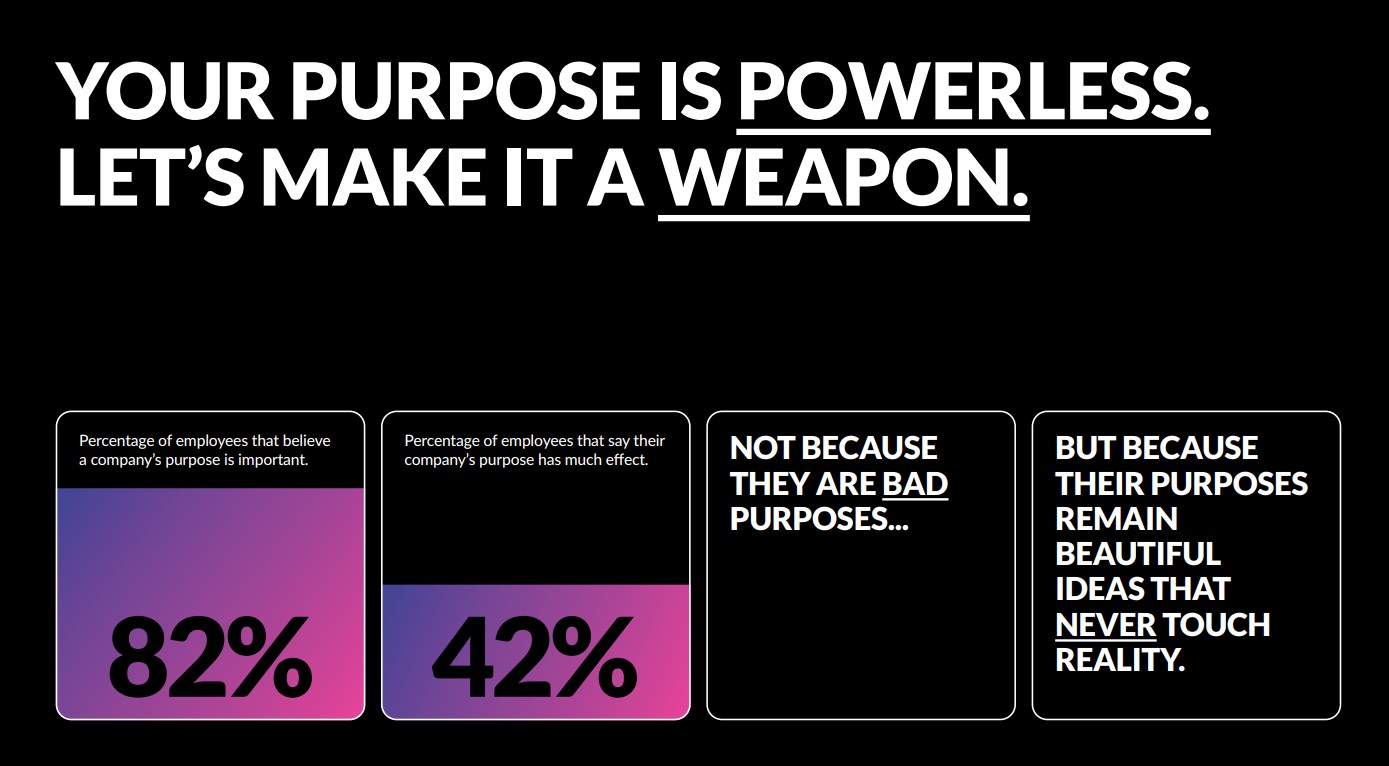
Deloitte reports that purpose-driven organisations achieve 30% higher levels of innovation and 40% greater workforce retention than competitors. Consumers are four times more likely to buy from brands with a clear purpose. And here’s the crime scene: McKinsey’s research reveals that 82% of employees believe purpose is important – yet only 42% say their company’s purpose has much effect. That 40-point gap? That’s not a research insight. That’s a confession. Purpose is being performed, not practiced. And your people can tell the difference.
Purpose is practical. Purpose is operational. Purpose is a speed advantage disguised as idealism.
In a world shaped by AI, shifting expectations, collapsing trust, and increasingly impatient customers, incrementalism is suicide. The companies that will thrive are the ones with a cause strong enough to unify teams, attract the undecided, and make bold moves that competitors are too cautious to take. Purpose is not a sentimental accessory. It is your competitive edge.
This is the moment to choose. You can stay in the comfort of mission-vision-value wallpaper and hope the market doesn’t notice. Or you can step into purpose with both feet and lead a business with clarity, courage, and coherence. The infinite game demands leaders who aren’t afraid to stand for something – even when the spreadsheet winces. Especially then.
Lead with purpose, and you create a company people want to fight for. Lead without it, and you’re building a business no one will miss when it’s gone.
Are you a member of the House of Rebel?
Members receive exclusive access to our purpose framework – the one that turns abstract conviction into operational advantage. Not fluffy. Not theoretical. Just the precise mechanism for unlocking momentum and breaking inertia inside your business.
INTERESTED IN FINDING OUT MORE?
Fill in your details below and we’ll be in touch
"*" indicates required fields